How to Read a Peptide Certificate of Analysis (with Example)
Read a complete fictional peptide certificate of analysis, interpret each test row and compare the report with three sample labels.
Start by matching the peptide description and lot number on the certificate to the container. Then read each result alongside its test method, acceptance criterion and unit. Check whether the report covers the bulk lot, a sample from that lot or a specific finished vial.
Match the lot, material and document
Place the container label, receiving record and certificate of analysis side by side. Copy the peptide name and any distinguishing form or terminal modification, the supplier lot number, the certificate identifier and revision, and the issuer. Preserve leading zeros and suffixes. If the certificate names a laboratory sample ID, find the submission or sampling record that connects that ID to the supplier lot. A matching product name can occur on certificates from different batches.
Copy dates with their labels. The test date tells you when an analysis was performed, while the issue date tells you when the document was released. A retest date identifies when material should be reevaluated under the stated system. Where a file says “page 1 of 2” or names a test attachment, confirm which pages and appendices you have before recording what the document supports.
Interpret each test result against its own criterion
A test row answers one analytical question. Read the attribute, procedure and revision if given, result, units and basis, and acceptance criterion together. Keep any reported qualifier, such as “below quantitation limit,” in your notes. If a row gives only “passes,” ask what comparison was made and whether the issuer can supply the observed result. Some identification methods legitimately report a qualitative comparison, while an assay may provide a numerical amount.
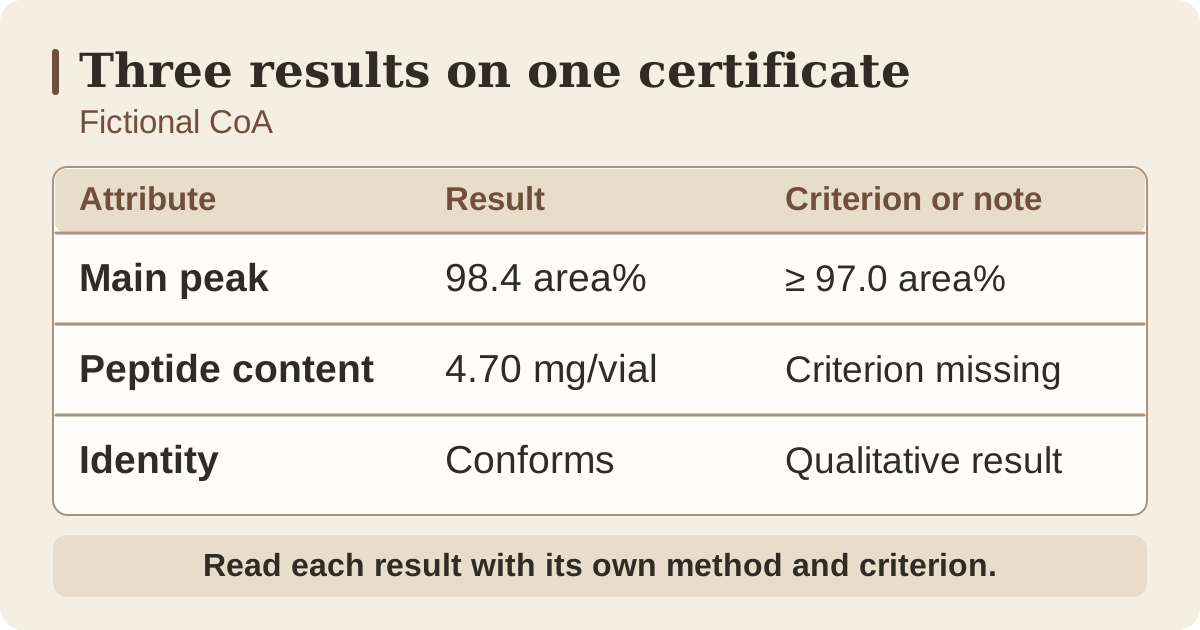
In a fictional certificate for lot CV-DEMO-014, the row “Main peak, HPLC–UV method RP-03, 98.4 area%, minimum 97.0 area%” meets its stated criterion on the reported figures. A second row, “Peptide content, calibrated assay AQ-07, 4.70 mg per vial,” describes the measured amount for the sample specified in that test. Copy the value as reported. Ask for the assay’s acceptance criterion before assigning it a pass or fail. A third row saying “identity conforms” can be recorded as the issuer’s conclusion, alongside the identity procedure or comparison if provided.
ICH Q7, API GMP guidance, §§ 7, 11.4 and 17 · EMA, Synthetic peptides guideline, §§ 2, 4.1, 4.3 and 4.4
Determine what the sample represents
Read the sample description closely. A report on powder drawn from a bulk lot may establish that a tested bulk specimen met a criterion. A content result on a finished vial represents the vial or set of vials defined in the report. If the lot is filled or repackaged after bulk testing, look for a record linking the source batch to the packed lot. If you need evidence about variation across finished vials, ask how many units were tested and how they were selected.
FDA’s ICH Q7 guidance gives a concrete document model in §11.4 for active pharmaceutical ingredients and intermediates. It describes batch identification, the tests performed, their acceptance limits and numerical results where applicable. Use it as a reference for reading document fields. For a research review, document the requirements that apply to your particular decision and who established them.
Save the exact certificate revision and any supporting files with a dated note. For example, “Lot CV-DEMO-014 matches the container label. The HPLC main peak meets the listed area criterion. The relationship between the assayed specimen and the received vial is awaiting documentation.” A colleague can use that note to request the missing link without repeating the whole review.
Read a worked certificate of analysis
Start with the report identity and sample trail. Use the result and acceptance columns to see which claims the issuer actually measured.
Fictional teaching reports. All issuers, identifiers, results and criteria below are simulated.
Certificate of analysis · TCOA-024
| Field | Fictional entry |
|---|---|
| Report and authorization | TCOA-024 / Rev 01 / page 1 of 1. Issued by Training Lab 04, authorized by teaching reviewer TR-04. |
| Material | Linear hexapeptide GAGKLV with free termini. Catalog EDU-HX06. Nominal 5.0 mg peptide equivalent per vial. |
| Tested sample | One sealed vial submitted by Classroom Supplier 02. Lab accession EDULAB-0251 is mapped to supplier lot EDU-L-0042. Individual vial ID is unreported. |
| Dates | Received 2026-08-10, tested 2026-08-12, issued 2026-08-13. |
| Supporting records | Referenced LC–MS spectrum TCOA-024-M, integration TCOA-024-H, and assay calculation TCOA-024-A. These attachments are outside the exercise. |
| Analyte or attribute | Method and basis | Unit | Result | Acceptance criterion |
|---|---|---|---|---|
| GAGKLV mass match | LC–MS M-07 Rev 02, deconvoluted neutral monoisotopic mass | Da | 543.339 | 543.338 ± 0.010 Da |
| Main chromatographic peak | RP-HPLC/UV H-04 Rev 03 at 214 nm, 984 of 1,000 integrated signal-area units | area % | 98.4 | ≥97.0 area % |
| GAGKLV amount in the tested vial | Calibrated HPLC/UV assay A-02 Rev 01, assigned-content reference | mg peptide equivalent per vial | 4.70 | 4.50–5.50 mg per vial |
| Endotoxin | Method unreported | Unreported | Not reported | Unreported |
The mass differs from the stated target by +0.001 Da. The area percentage uses the integrated UV signal as its denominator. The reported amount comes from a separate calibrated assay. Ask the issuer about the scope of any unreported test.
Second report · TCOA-027
Training Lab 04 issued TCOA-027 / Rev 02 / page 1 of 1 on 2026-08-20 after testing on 2026-08-19. It lists material EDU-HX06 and lab accession EDULAB-0257. The supplier lot and the intake record that would link it to the accession are unreported.
| Analyte or attribute | Method and basis | Unit | Result | Acceptance criterion |
|---|---|---|---|---|
| GAGKLV mass match | LC–MS M-07 Rev 02, deconvoluted neutral monoisotopic mass | Da | 543.340 | 543.338 ± 0.010 Da |
| Vial label | Label lot | Report / accession | Reported lot | Document finding |
|---|---|---|---|---|
| A · BOX2-05 | EDU-L-0042 | TCOA-024 Rev 01 / EDULAB-0251 | EDU-L-0042 | Exact lot match. The individual vial link remains open. |
| B · BOX2-06 | EDU-L-0044 | TCOA-027 Rev 02 / EDULAB-0257 | Unreported | Missing link. Ask for the accession-to-lot record. |
| C · BOX2-07 | EDU-L-0043 | TCOA-024 Rev 01 / EDULAB-0251 | EDU-L-0042 | Lot conflict. Request the correct report or a documented correction. |