How to Match a COA to a Lot, Sample and Lab Report
Follow the container lot through the supplier and laboratory records, and document where the evidence trail ends.
Match the container’s lot number to a report or a documented mapping from that lot to a laboratory sample ID. Verify the report number and revision with the issuer when needed. The report’s applicability depends on how the tested sample was linked to the material received.
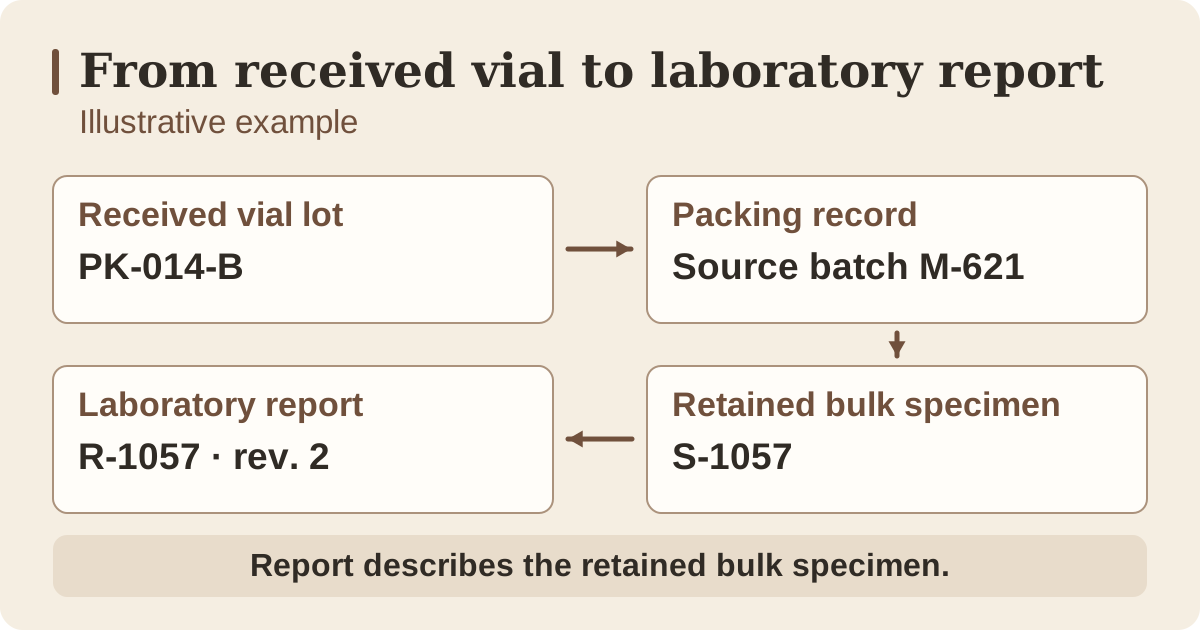
Build the identifier chain
Start with the physical container. Record the complete lot number, label description and unique container ID if present. Copy the packing or receiving record that associates the lot with your shipment. On the report, identify the sample description, accession number, submitter, issuer, report number and revision. If one organization used a manufacturing batch ID and another assigned a packaged lot, preserve both identifiers and record who assigned each one.
An example chain might run from a vial labelled PK-014-B to the supplier’s packing record for bulk batch M-621, then through a submission record for retained bulk sample S-1057 to laboratory report R-1057, revision 2. Each link should name or clearly map the adjoining identifiers. A missing suffix can be material if the suffix distinguishes pack dates, sublots or material forms. Ask the organization that assigned the identifier to explain an apparent match.
Verify the issuer and the link as two checks
Use contact information from the issuer’s official site or an accreditation body’s directory to ask about the report number, issue date and revision. The issuer may be able to confirm that a report is authentic while restricting disclosure of customer details. Global ACI directs buyers to the issuing conformity assessment body first when checking an accredited report. For a distributor’s certificate, ask which tests were performed by the original manufacturer or a separate lab, and request the underlying report or documented mapping where it matters.
Then check the chain that led to the laboratory sample. For example, an issuer confirms report R-1057 and sample S-1057, while the shipment label shows PK-014-B. Record the document as confirmed with the issuer. If the submission record maps S-1057 to a different bulk batch, record that mismatch and request the report tied to the shipment. If the submission record has yet to be supplied, record the lot link as unverified.
| Field or evidence | Case A · Documented link | Case B · Report confirmed, lot link open |
|---|---|---|
| Received label | Vial U-17, packaged lot PK-014-B | Vial U-32, packaged lot PK-031-A |
| Supplier lot and packing record | Packing record PKR-14 connects PK-014-B to source batch M-621. | Receiving record confirms PK-031-A. No packing or batch mapping was supplied. |
| Laboratory specimen | Submission SUP-1057 maps retained bulk from M-621 to accession S-1057. | The report identifies S-0116 as one submitted vial. Its relationship to PK-031-A is unreported. |
| Issuer, report and revision | Teaching Lab North confirms R-1057, rev. 2, for S-1057. | Teaching Lab North confirms R-116, rev. 1, for S-0116. |
| Finding | The records link the received lot to the tested source batch. The test result concerns retained bulk. | The issuer confirms the document. A record connecting its sample to the received lot is still needed. |
Ask the issuer. “Can you confirm R-116 revision 1, its issue date, and which specimen your accession S-0116 identifies?”
Ask the supplier. “Can you provide the submission or sampling record that connects accession S-0116 to the lot PK-031-A on our vial?”
Some suppliers let you retrieve a certificate by catalog number and lot in their document portal. Record the identifiers you entered and the exact document revision you retrieved. Use the same specimen and lot checks for a lab report attached to the portal record.
Decide how far the sample can represent the lot
In the fictional PK-014-B chain, a retained bulk specimen may be representative of the bulk material if supported by the sampling record. If the review concerns the amount in the finished vial, a bulk assay provides different evidence. A submission of one finished vial also supports a narrower statement than a study that sampled several identified vials across a filling run. Ask who selected the units, what stage of production they represented, and how samples were labelled and transferred. Write the narrowest conclusion that the available chain supports.
Use a dated note with three elements. Name the verified report revision, cite the record connecting the sample and lot, and state the exact remaining question. For example, “Lab confirmed R-1057 rev. 2. Packing record PK-014-B maps to M-621. Submission record identifies S-1057 as retained bulk from M-621. Finished-vial assay pending.” If a revision changes the lot field or numerical result, preserve both versions and record the issuer’s explanation. ICH Q7 addresses records and CoAs in the regulated API supply chain and provides useful models for source-batch and repackaging records.